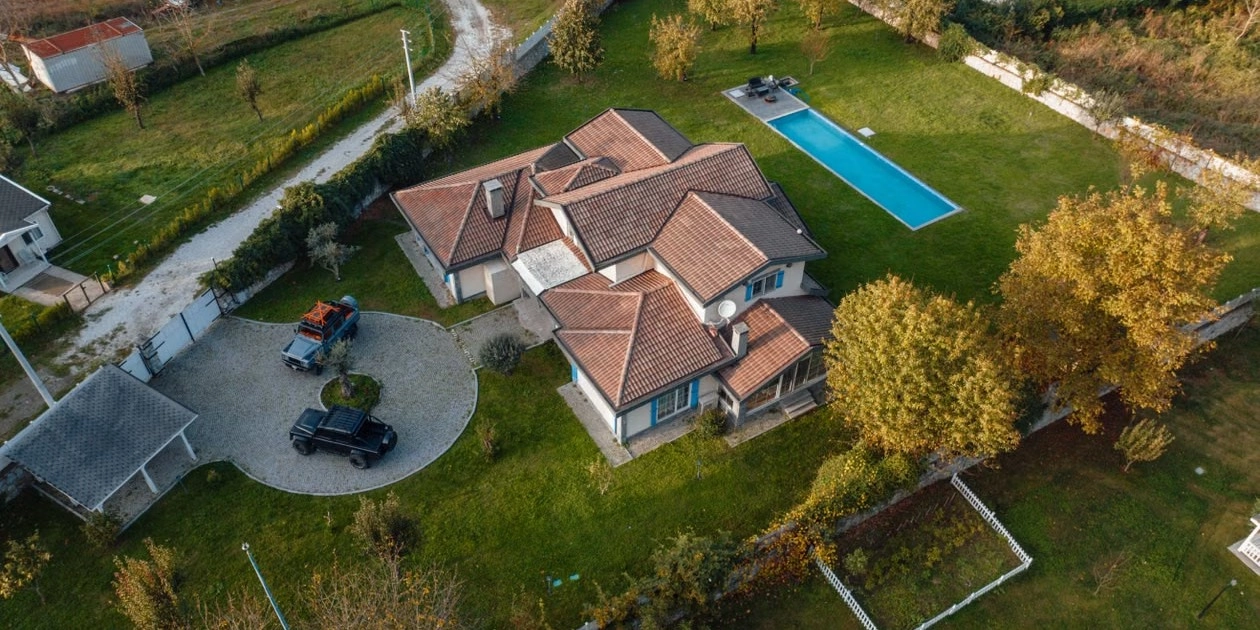
Aerial footage has become one of the most visually compelling tools in real estate videography, but compelling and cost-effective are not always the same thing. Plenty of agents have commissioned drone video for a standard suburban block, paid a premium for the production, and ended up with footage that told buyers very little a well-shot interior walkthrough could not have communicated more effectively at half the price.
The decision to add drone footage to a listing deserves more scrutiny than it typically receives. The property type, the lot size, the surrounding environment, and the licensing status of the operator all determine whether aerial video earns its place in a campaign or simply adds to the budget.
This post works through each of those considerations in practical terms. You will find a clear breakdown of the property types where drone footage genuinely performs, the scenarios where it routinely underdelivers, what NSW regulations actually require of commercial drone operators under CASA rules, and how to evaluate a quote before you commit. The goal is a sharper framework for matching the format to the listing, every time.
Aerial footage earns its cost when the property has something a ground-level lens cannot show. That condition applies more selectively than most agents assume.
Land scale is the clearest case. A holding large enough that its scale cannot be communicated from street level gives drone footage a genuine job: communicating size to a buyer who is otherwise working from a floor plan and a street photo. You cannot convey two hectares from the kerb.
Coastal, waterfront, and elevated properties are the second strong case. When the aspect is the primary selling point, aerial framing delivers it in seconds. A single drone pass over a cliff-top block in the Northern Beaches tells a buyer more about the view than any interior shot could, regardless of how well it is composed.
Distinctive architecture and resort-style landscaping that read poorly from street level, complex rooflines, geometric pool surrounds, structured garden terracing, justify a top-down or orbiting perspective as part of a real estate video production package. These features exist at a scale and angle that ground-level video simply cannot resolve cleanly.
Proximity to landmarks is underused as a justification. A single aerial clip can establish that a property sits 400 metres from a national park boundary, or that the CBD skyline is visible from the upper level, context that would otherwise require three sentences of listing copy and still feel unverifiable to a buyer.
Rural holdings and hobby farms represent the strongest return on investment across all property categories. When a buyer needs to spatially understand the relationship between paddocks, sheds, fencing lines, and access tracks before committing to an inspection, drone photography for real estate is not a marketing add-on. It is functional information the listing cannot do without.
The flip side of that list is equally useful. Where none of those conditions apply, drone footage has almost no job to do.
Take a standard suburban block on a flat grid street. A three-bedroom terrace in Marrickville, a brick veneer in Penrith. From the air, you get a roofline, a small backyard, and the neighbours crowding the frame on both sides. Nothing in that image moves a buyer closer to booking an inspection.
Buyers in the metropolitan market for a typical three-bedroom home are making decisions based on internal layout, natural light, kitchen condition, and bathroom finishes. A well-executed interior walkthrough addresses all four directly. A bird's-eye clip addresses none of them. Interior walkthroughs typically address buyers' core decision criteria more directly than aerial-only footage, because they replicate the experience of walking through the property, which is precisely what a buyer is mentally rehearsing when they're deciding whether to attend an open home.
The cost question compounds this. A licensed, compliant drone operation in NSW carries real production cost, reflecting proper credentials, insurance, and safety systems. On a property where aerial footage delivers no marginal information to the buyer, that spend produces no return. If you want to understand what do you need delivered before committing to a format, the project calculator is a reasonable place to start.
There is also a strategic argument for restraint. Agents who add drone footage to every listing regardless of property type gradually erode its impact. When aerial footage appears on a coastal acreage and a Penrith three-bedder in the same week, it signals a production default rather than a considered marketing choice. Vendors notice, and buyers certainly do. For properties defined by their physical space and presentation, any business with a physical space benefits from format choices that match what actually needs to be communicated, not what sounds most impressive in a brief.
Choosing the wrong operator costs more than just money. Here is where the regulatory picture matters.
Any drone work commissioned for a real estate listing, where an agent pays for the service, is a commercial operation under Australian federal law. CASA's drone rules draw a clear line: recreational flying requires no licence, but any operation conducted for hire or reward immediately falls under Part 101 of the Civil Aviation Safety Regulations. The relaxed hobbyist rules do not apply.
Compliance under Part 101 requires two separate credentials. The individual flying the drone must hold a Remote Pilot Licence (RePL), obtained through a CASA-approved training provider. The company they operate under must hold a Remote Operator's Certificate (ReOC). One does not substitute for the other. A pilot with a RePL working under an unaccredited company is operating outside the law, as is a company holding a ReOC whose pilots lack current individual licences.
The ReOC framework is not a rubber stamp. It requires documented safety management systems, approved operational procedures, and insurance coverage for commercial aerial work. Operators without these credentials are not simply behind on paperwork; they are in breach of federal aviation law.
This matters practically because the compliance gap in NSW real estate is genuine. Operators quoting well below market rate frequently lack proper accreditation. The cost saving reflects missing infrastructure, not operational efficiency. If one of those operators causes an incident or a privacy complaint, the liability does not stay neatly with them. The agent who commissioned the work may share exposure, particularly if they failed to verify credentials before booking.
Privacy adds a separate layer. Aerial filming that captures neighbouring properties, private spaces, or identifiable individuals without consent creates obligations under NSW law that sit entirely outside Part 101. A properly accredited operator will have consent and geofencing protocols built into their standard workflow, not treated as an afterthought.
Before booking any operator, ask for their RePL number and ReOC certificate, then verify both on the CASA register. It takes five minutes.
Knowing the compliance requirements is one thing. Having a short list of questions ready before you pick up the phone is what actually protects the booking.
Can you provide your RePL number and ReOC certificate for verification on the CASA register? Verify both on the CASA register before confirming the booking.
What does your public liability insurance cover, and does the policy specifically include commercial aerial filming? It is worth confirming in writing that the policy covers the specific work you are commissioning, verbal assurances of being "fully insured" are not sufficient.
Have you flown in this suburb before, or near a similar property type? Controlled airspace near major airports and CASA-designated flight restriction areas can complicate a shoot. An operator familiar with the local area will know the airspace situation in advance, not on the morning of the shoot.
What are the deliverables, and what is your turnaround time? For real estate video production, the standard expectation is edited clips cut for listing platforms and at least one social format, not raw footage handed over on a USB. Confirm the edit scope before any quote is accepted. The same principle applies to location shoots in general: unclear deliverable scope causes more post-production disputes than almost anything else, a point covered in more detail in the context of filming in uncontrolled locations.
What is your weather cancellation policy? Rain, wind above safe operating thresholds, and low cloud all ground drone operations. An operator with a clear rescheduling policy, and transparent terms around any associated costs, removes a variable that can otherwise become a problem on a listing with a fixed campaign launch date.
Once you have compliance answered and a qualified operator confirmed, the next decision is whether the footage will actually do anything useful once it goes live.
On Domain and realestate.com.au, an aerial clip set as the listing video header works hardest when land, aspect, or setting is what the property is selling. The same clifftop example established earlier illustrates the point for listing headers. The same logic inverts on a standard suburban block, the value is inside.
The format logic on social platforms follows the same principle: dramatic aerial footage of a coastal or prestige property has genuine visual contrast against standard social content, and that contrast has practical value when the property warrants it. A suburban roofline does not stop anyone scrolling. In practice, for agents working in commercial or prestige segments, aerial footage of a significant landholding or development site may serve a different audience purpose entirely, developers and investors assessing scale and access respond to different visual cues than residential buyers. Residential aerial clips rarely earn engagement in those contexts.
When agents commission drone footage on an unremarkable block, the aerial clip is typically skipped in favour of the interior gallery. That pattern is worth tracking across your own listings as a simple calibration tool.
For properties where both formats are warranted, pairing a drone exterior with a full interior walkthrough addresses both spatial context and the interior detail that drives inspection decisions, neither format alone covers both needs. As this breakdown of production decisions and their real impact illustrates, format choices compound.
Once you know where drone footage performs, the next question is what it costs and whether that cost holds up against the property you're marketing.
Compliant, licensed drone work runs at a higher rate than the cheaper operators you'll occasionally see quoting well below the market. As covered in the compliance section, a legitimate operator's rate reflects the cost of RePL, ReOC, and aviation-grade insurance, not margin inflation.
Pricing across Sydney and NSW varies by shoot complexity, property type, and scope. A standalone drone clip for a straightforward suburban shoot sits in one bracket. A full real estate video production combining an interior walkthrough, aerial exterior, and edited social cuts sits in a considerably higher one. Bundled packages almost always deliver better value per deliverable than booking each element separately, because the operator is already on site and post-production can be structured efficiently across formats.
These are estimates only. Actual costs depend on the property's location, access requirements, airspace constraints, and the scope of post-production involved. For a tailored figure, use the 618 Media Video Project Calculator or contact the team directly to discuss your specific listing.
When presenting drone costs to a vendor, frame the spend against the price point. On a high-value coastal or rural acreage, a compliant drone package is a marginal line item relative to the sale commission. On a standard metropolitan unit, the same spend needs a clearer justification, and in most cases, a well-shot interior walkthrough will make that argument more effectively than an aerial clip of an unremarkable roofline.
The decision framework is straightforward once you strip out the defaults. The property-type framework above sets out where aerial footage earns its place and where an interior walkthrough does more work for less spend.
The compliance checklist, RePL, ReOC, and aviation-specific insurance, is covered in full above; apply it on every booking.
For properties where aerial footage is genuinely warranted, bundling a drone exterior with a full interior walkthrough consistently outperforms either format alone. Buyers get the spatial context the aerial provides and the interior detail that actually drives inspection decisions. That combination, delivered as a single real estate video production package, tends to deliver stronger listing page performance than drone footage commissioned in isolation.
618 Media produces real estate video across Sydney and NSW, covering interior walkthroughs, drone exteriors, and combined packages. For a project estimate, use the Video Project Calculator to get a starting figure based on your listing's scope, or contact the team directly to talk through what your specific property actually needs.
Not sure what video you need? Use our free Video Project Calculator to get a tailored recommendation and rough estimate in under 2 minutes.
Use the CalculatorDrone footage is worth the investment when the property has features that cannot be effectively captured from ground level. This includes large landholdings where scale needs to be communicated, coastal or waterfront properties where views are the primary selling point, elevated properties with distinctive aspects, unique architecture or resort-style landscaping, properties near notable landmarks, and rural holdings or hobby farms. For standard suburban blocks on flat grid streets, an interior walkthrough typically delivers better return on investment.
Any drone work commissioned for real estate is considered a commercial operation under Australian federal law and must comply with CASA's Part 101 regulations. The operator must have two separate credentials: a Remote Pilot Licence (RePL) for the individual flying the drone and a Remote Operator's Certificate (ReOC) for the company. Both credentials require verification on the CASA register before booking. Operators lacking these credentials are operating outside the law, and agents who commission unlicensed work may share liability for any incidents or privacy complaints.
Before booking, ask for their RePL number and ReOC certificate for CASA verification, confirm their public liability insurance specifically covers commercial aerial filming, verify they've flown in the suburb or similar property types (important for airspace considerations), clarify the exact deliverables and turnaround time (should include edited clips for listing platforms and social formats, not raw footage), and understand their weather cancellation and rescheduling policy. These questions protect your booking and ensure professional compliance.
Operators quoting well below market rate frequently lack proper accreditation and compliance infrastructure. The cost savings reflect missing credentials, inadequate insurance, and undocumented safety management systems—not operational efficiency. Engaging an unlicensed or under-insured operator exposes the agent to liability if an incident occurs. Compliant, licensed drone work necessarily carries higher costs due to RePL and ReOC requirements, aviation-grade insurance, and proper safety systems.
Yes, pairing drone exteriors with full interior walkthroughs consistently outperforms either format alone. Aerial footage provides spatial context and communicates the property's setting and scale, while interior walkthroughs address the interior layout, natural light, kitchen condition, and bathroom finishes that drive inspection decisions. This combined approach as a single real estate video production package delivers stronger listing page performance, and bundled packages typically provide better value per deliverable than booking each element separately.
618 Media is a video production company based in NSW, working with businesses, artists, and organisations across Sydney and NSW on music videos, brand stories, corporate video, event coverage, real estate, social media content, and more.
Every project starts with a conversation about what you want to achieve. We handle everything from concept through to final delivery.
Get in TouchFill in your details and a member of the 618 Media team will get back to you personally.
A team member reviews every message personally. No automated replies.
Message received. The 618 Media team will get back to you personally, usually within a few hours on business days.
